Washable electrostatic precipitation — the low-cost alternative to throwaway HEPA filters
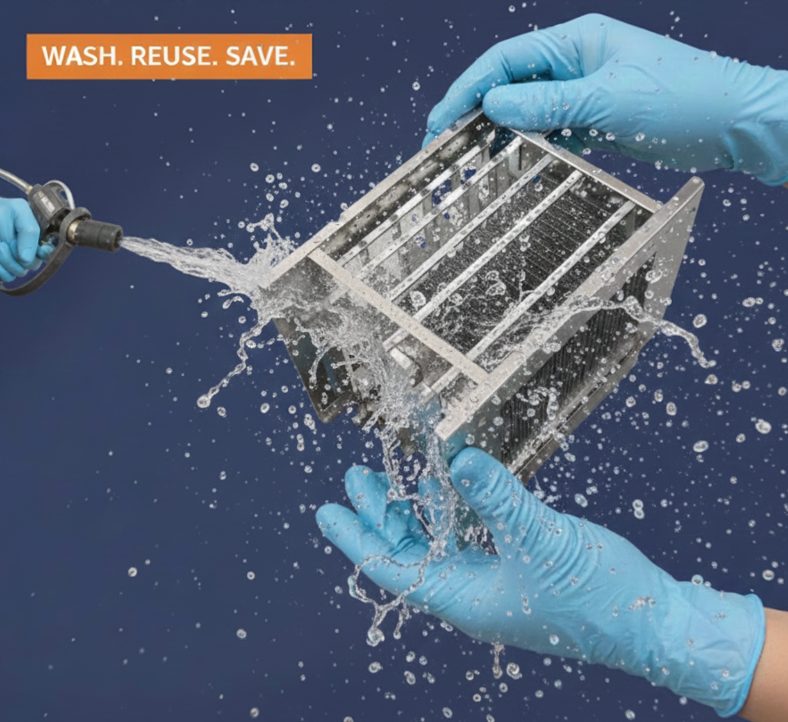
Most fume extractors force air through disposable HEPA filters that clog, cost hundreds of dollars to replace, and ship to landfill. Reborix ESP (electrostatic precipitation) captures the same fine smoke particles on washable metal plates — no disposable filter media, near-zero running cost, and constant airflow for the life of the machine. This page explains how it works, how to maintain it, and what it really costs.
ESP works like a magnet for smoke. It uses a high-voltage electric field (8–12 kV) to give particles an electric charge, then pulls them onto grounded metal collection plates where they stick.
The result: 99.97% particle capture down to 0.1 μm (HEPA is rated at 0.3 μm) and 96–99% odor removal — the exact size range produced by laser cutting, marking, and engraving smoke.
HEPA filters are excellent for dry dust — but laser fumes are oily, sticky, and submicron. That's exactly what clogs a HEPA filter and exactly what ESP plates handle best.
| Factor | ESP (Reborix 12 Series) | HEPA H13 |
|---|---|---|
| Particle range | 0.1 μm (99.97%) | 0.3 μm (99.97%) |
| Best for | Oil smoke, VOCs, sticky fumes | Dry dust, metal powder |
| Filter replacement | Washable (every 3–5 yr at most) | Replace (every 6–18 mo) |
| 5-year consumable cost | ~$290–500 | ~$1,300–3,775 |
| Back-pressure | Constant (no clogging) | Increases as it loads |
| Ozone | Trace (below OSHA limit)* | None |
* Reborix ESP cells operate below OSHA's 0.1 ppm exposure limit; the post-ESP carbon stage neutralizes residual ozone.
The collection cell itself is washable and never needs replacing under normal use. Only two low-cost consumables exist.
| Component | Maintenance | Frequency | Cost per Service |
|---|---|---|---|
| Pre-filter mesh | Remove, wash, dry, reinstall | Every 1–2 weeks | $0 (washable) |
| ESP electrostatic cell | Remove, soak in degreaser, rinse, dry | Every 1–3 months | $0 (washable) |
| Carbon fiber cotton | Replace | Every 6–12 months | $10 |
| Activated carbon granules | Replace | Every 12–18 months | ~$80 |
⚠️ Important: After cleaning, allow the ESP module to dry completely before reinstalling and operating the machine. Installing a wet or damp ESP module may cause electrical short circuits or equipment faults.
Buy a spare ESP cell ($200) and rotate them — one in use, one drying or standing by. You'll never wait 24 hours for a cell to dry mid-production.
Heavy MDF or acrylic cutting produces more smoke, so plan to clean every 2–4 weeks instead of 1–3 months.
Order Spare ESP Cells →| Cost Item | 12 Series (ESP) | Competitor HEPA-Only |
|---|---|---|
| Filter replacements | $0 (washable ESP cell) | $1,200–3,600 |
| Carbon fiber cotton ($10 × 5–10) | $50–100 | N/A (or in HEPA) |
| Activated carbon granules ($80 × 3–5) | $240–400 | $100–175 |
| 5-Year Total | $290–500 | $1,300–3,775 |
A Reborix ESP 12 Series saves ~$800–3,500 over 5 years vs a HEPA-only competitor. 💰
Want the full schedule for every line? See our maintenance & cost guide.
The ESP-based 12 Series runs on washable electrostatic technology — from the desktop 12-1 to the 3,000 m³/h 12-5S. See every model side-by-side.
500 m³/h | 0.9 kW | 55 kg. 4-stage ESP. The workhorse for laser marking and 6040 cutters.
View Details →1,000–1,800 m³/h. 6-stage ESP + UV + ion. For 1390 and 1325 CO₂ laser cutters.
View Details →3,000 m³/h | 3.4 kW | 168 kg. 8-stage ESP for multi-1390 or single 1325 high-volume cutting.
View Details →Airflow, power, noise, weight, and stage count for every ESP model in one table.
Compare All Models →A high-voltage field (8–12 kV) ionizes airborne particles as air passes through. Charged particles are then attracted to grounded collection plates like a magnet, capturing 99.97% of particles down to 0.1 μm (vs HEPA's 0.3 μm) and removing 96–99% of odors. A downstream activated-carbon stage removes residual VOCs and odor.
Every 1–3 months under normal operation, more often for heavy MDF or acrylic cutting. Wash with warm water and an alkaline degreaser, then dry completely (about 24 hours) before reinstalling. A spare cell ($200) lets you rotate during drying.
About $290–500 in consumables over 5 years, versus $1,300–3,775 for a HEPA-only system. The ESP collection cell is washable and never needs replacing under normal use — only the carbon cotton and activated carbon granules are replaced.
No. Reborix ESP cells operate at voltages that produce ozone well below OSHA's 0.1 ppm exposure limit, and the post-ESP activated carbon stage further neutralizes any residual ozone.
Switch to washable ESP. Tell us about your laser and materials — we'll recommend the right 12 Series model.
Get an ESP Recommendation →