Why a washable filter changes the whole running-cost picture for welding fume extraction
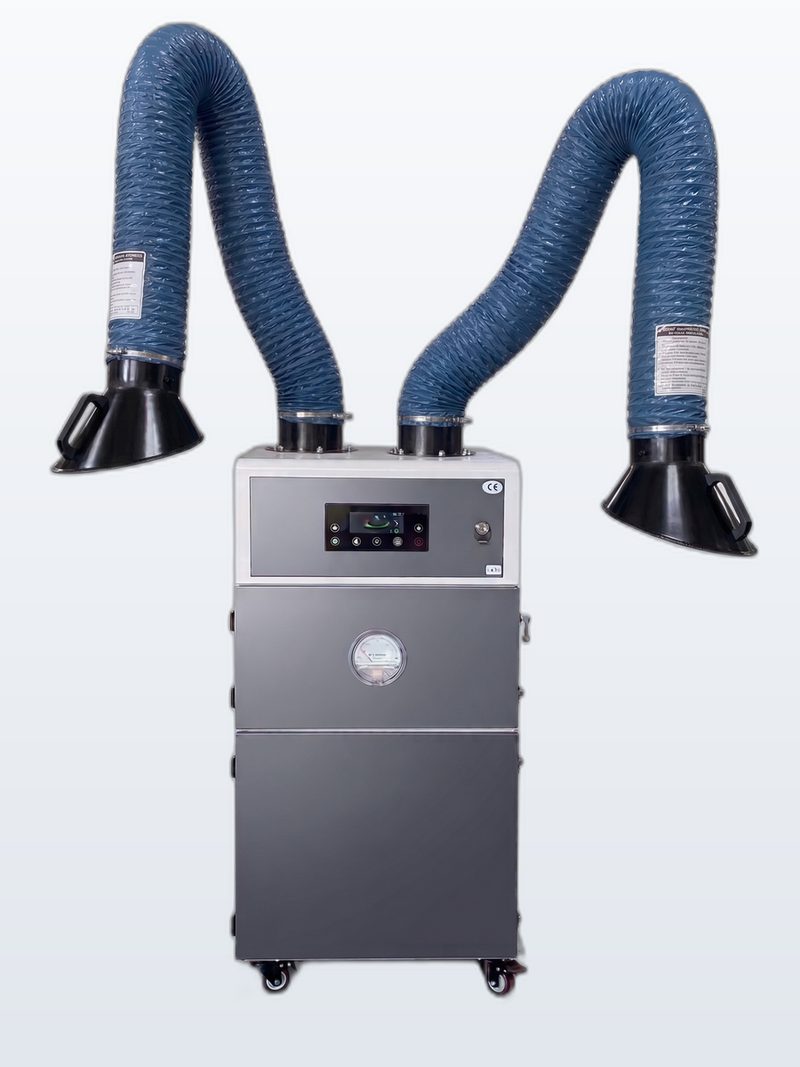
Hand-held fiber laser welding produces a lot of fine metal powder — exactly the kind of dust that clogs a standard HEPA filter in weeks. The Reborix FH-8/8S takes a different approach: washable PTFE membrane cartridges instead of disposable HEPA. Rinse them clean, run automatic pulse cleaning, and you replace the filters about once a year instead of every few months. Here's how that works.
Fiber laser welding — and hand-held welding in particular — vaporizes metal into an extremely fine powder. That dust is:
A traditional HEPA filter catches this dust well — but it's disposable. Once the media loads up, you can't clean it. Water destroys the fiber matrix, and back-blowing a glass-fiber HEPA only recovers a fraction of the airflow. So the filter gets thrown away and replaced, over and over.
The FH-8/8S uses PTFE (polytetrafluoroethylene) membrane cartridges instead of traditional HEPA media. The difference comes down to the material:
| Property | PTFE membrane cartridge | Traditional HEPA |
|---|---|---|
| Washable | Yes — rinse with water | No — water damages the media |
| Dust release | Smooth, low-friction surface sheds dust easily | Fibrous media holds dust in the matrix |
| Pulse cleaning | Highly effective — dust cake drops off cleanly | Partial recovery only |
| Efficiency | 99.9% at 0.3μm | 99.97% at 0.3μm (H13/H14) |
| Typical replacement | ~1 year (usage-dependent) | Every 3–6 months under heavy load |
PTFE is hydrophobic — it repels water. That's why you can take the cartridge out, rinse the metal dust off with water, let it dry, and put it back in. You simply can't do that with a HEPA filter. Combined with the machine's automatic pulse back-blow, the cartridge stays breathing much longer.
Both models use a 3-stage filtration train, so no single filter does all the work:
The pulse back-blow system automatically blasts the cartridges with reverse air during operation, knocking the dust cake into the collection tray. That automatic cleaning — plus the ability to wash the cartridge by hand — is what stretches the filter life to roughly a year.
Here's the maintenance rhythm we recommend for the FH-8/8S:
That's the difference from HEPA in practice: where a HEPA machine might see 2–4 filter changes a year, the FH-8/8S typically needs one. Over a year, cartridge replacement runs about $120–200 — and you're not paying a technician to swap disposable filters every quarter.
| Model | Airflow | Power | Weight | Best for |
|---|---|---|---|---|
| FH-8 | 1,000 m³/h | 1.2 kW | 85 kg | Single hand-held welding station |
| FH-8S | 3,000 m³/h | 2.3 kW | 103 kg | Higher airflow, programmable pulse cleaning |
Both run on the same PTFE cartridge platform. The FH-8S is the upgraded build — triple the airflow and programmable pulse cleaning for shops that run continuously or weld heavier material. If you're welding on one bench, the FH-8 is plenty; if you're running multiple stations or high-power fiber welding, step up to the FH-8S.
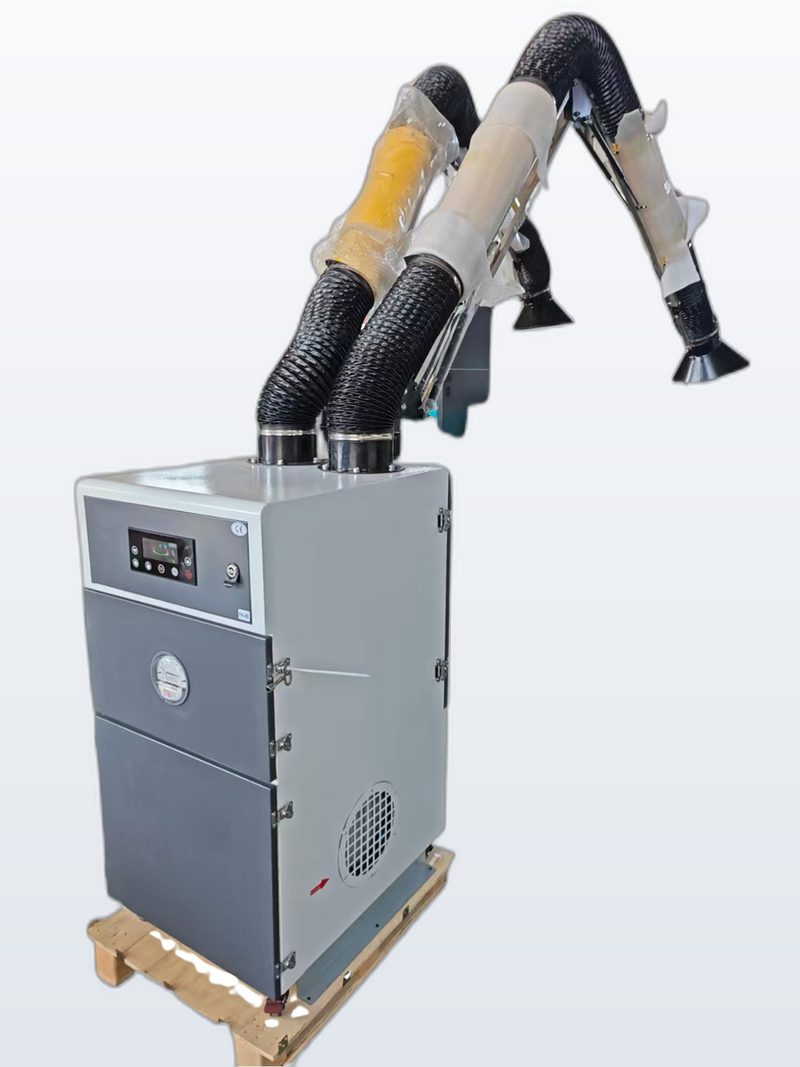
Welding fume clogs disposable HEPA filters fast. The FH-8/8S avoids that cost by using washable PTFE membrane cartridges you can rinse clean and reuse, backed by automatic pulse cleaning — so you replace filters about once a year instead of every few months. Same 99.9% particle capture at 0.3μm, a fraction of the filter bill.
Welding with a fiber laser or hand-held torch? See the full FH-8 Series here, or tell our engineers your setup and we'll recommend the right model and airflow.
Tell us your laser type, power, and number of stations — get an FH-8 configuration matched to exactly what you weld.
Request a Recommendation →