Fume extraction for laser welding, marking, and interior trim cutting in automotive production
The automotive industry is rapidly adopting laser technology: fiber laser welding for body-in-white and EV battery packs, laser marking for traceability (VIN codes, QR codes on components), and CO₂ laser cutting of interior textiles and plastics. Each process generates distinct contaminants requiring different filtration technologies from the Reborix catalog.
| Process | Materials | Contaminant | Recommended | Technology |
|---|---|---|---|---|
| Fiber laser welding (body panels) | Steel, aluminum, galvanized | Metal fume, zinc oxide | FH-8, FH-8-2 | PTFE membrane cartridge, pulse cleaning |
| Fiber laser welding (multi-robot cell) | Steel, aluminum | Heavy metal dust | FH-8-3, FH-8-4 | Modular central PTFE, expandable inlets |
| Laser cleaning (mold, rust removal) | Metal surfaces | Ablated particles, rust dust | FH-8S | PTFE membrane, programmable pulse, 3,000 m³/h |
| Battery pack welding (EV) | Aluminum, copper, nickel | Conductive metal dust | FH-8S | Pulse back-blow, 3,000 m³/h, 24/7 rated |
| High-power fiber cutting (chassis) | 3–12 kW fiber laser | Fine metal dust | 8-2, 8-3, 8-4 | PTFE cartridge, 380V 3-phase, 99.9% @ 0.3μm |
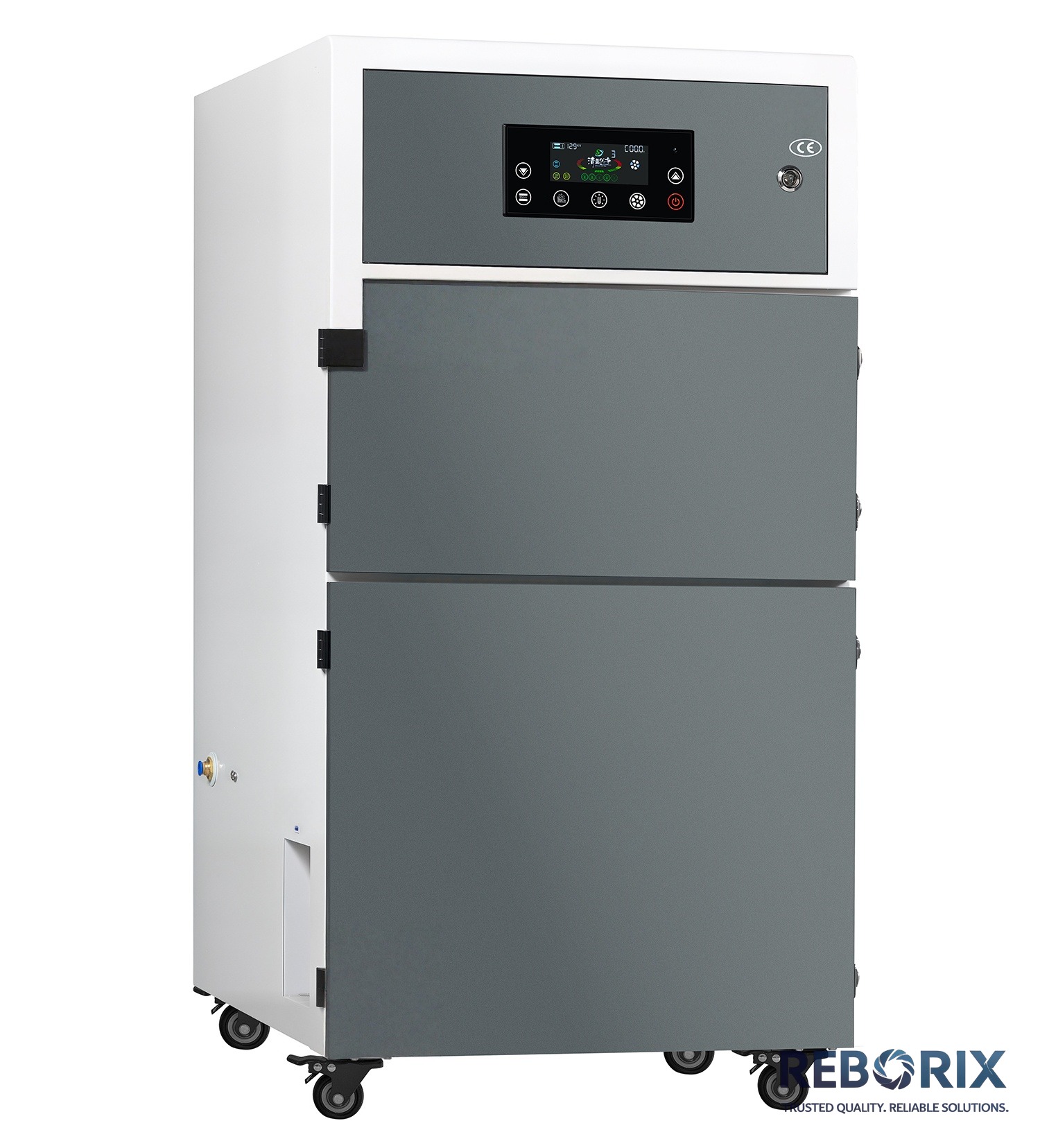
1,000–6,000 m³/h. FH-8/8S for robotic welding cells, FH-8-3/4 for multi-robot central extraction. PTFE membrane with pulse back-blow. 24/7 rated.
View Details →4,000–11,000 m³/h. 380V 3-phase, PTFE membrane cartridge. For 3–12 kW fiber laser cutting of chassis components. 99.9% @ 0.3μm, 24/7 production rated.
View Details →We provide IATF-ready documentation and OEM branding for Tier 1 suppliers.
Request Automotive Solution →